

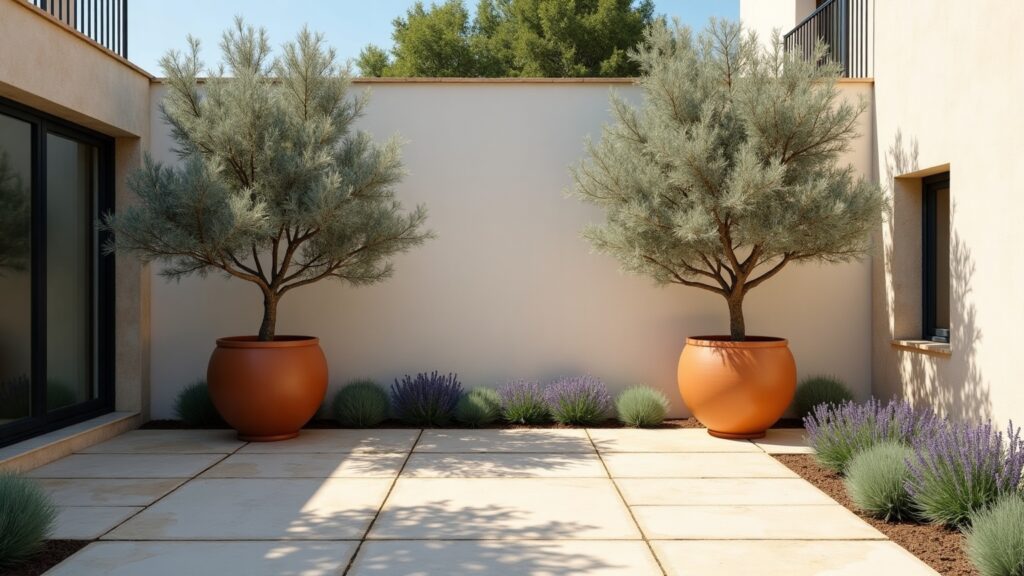
A Mediterranean garden built around olive trees needs three things: sharp drainage, at least six hours of direct sun, and a plan for winter if you garden below USDA zone 8. Get those right and the rest — gravel, terracotta, lavender, limestone — is styling. An olive in a pot is realistic in almost any climate; an olive in open ground is not. This guide covers which variety to buy, how to keep it alive, what to plant with it, and how to see the finished look on a photo of your own garden before you spend anything.
Which olive variety to actually buy
Garden centres often sell olives simply labelled Olea europaea, which tells you nothing useful. Variety determines how hardy the tree is, how big it gets, and whether it will ever fruit outside a hot climate. These five cover most of what is sold as ornamental stock in Europe and North America:
| Variety | Hardy to | Mature height | Best for |
|---|---|---|---|
| Arbequina | about −9 °C | 3–5 m | Pots and small courtyards. Compact, self-fertile, the usual choice for containers. |
| Leccino | about −12 °C | 6–10 m | The hardiest common variety. Pick this if it will stay outdoors in a marginal climate. |
| Frantoio | about −9 °C | 6–8 m | Classic Tuscan silhouette, weeping habit. Wants a warm, sheltered spot. |
| Picholine | about −10 °C | 5–7 m | Upright and narrow — good where a spreading canopy will not fit. |
| Mission | about −10 °C | 7–10 m | Dense, dark canopy. Widely grown in California, less common in Europe. |
One detail that matters more than variety: buy a tree with a thick, gnarled trunk if the look is the point. A slim 3-year-old whip and a 30-year-old specimen are the same species but a completely different design object, and the price gap reflects it.
Will it survive your winter?
This is where most Mediterranean garden projects fail, and the honest answer depends on where you are:
- USDA zone 9–11 (coastal Spain, southern Italy, Greece, California, Florida): plant in open ground, no protection needed.
- USDA zone 8 (southern UK, coastal France, Pacific Northwest, US South): open ground works in a sheltered, south-facing spot with free-draining soil. Expect leaf damage in a hard winter.
- USDA zone 7 and below (most of Poland, Germany, the US Midwest and Northeast): containers only. Move the pot into an unheated garage, porch or greenhouse once temperatures stay below −5 °C, and water it sparingly — roughly once a month — through the dormant period.
It is wet cold, not dry cold, that kills olives. A tree sitting in saturated soil at −5 °C is in far more danger than the same tree in dry soil at −10 °C. If you do nothing else, get the drainage right.
The five ingredients of the look
Strip away the styling and every convincing Mediterranean garden uses the same five components:
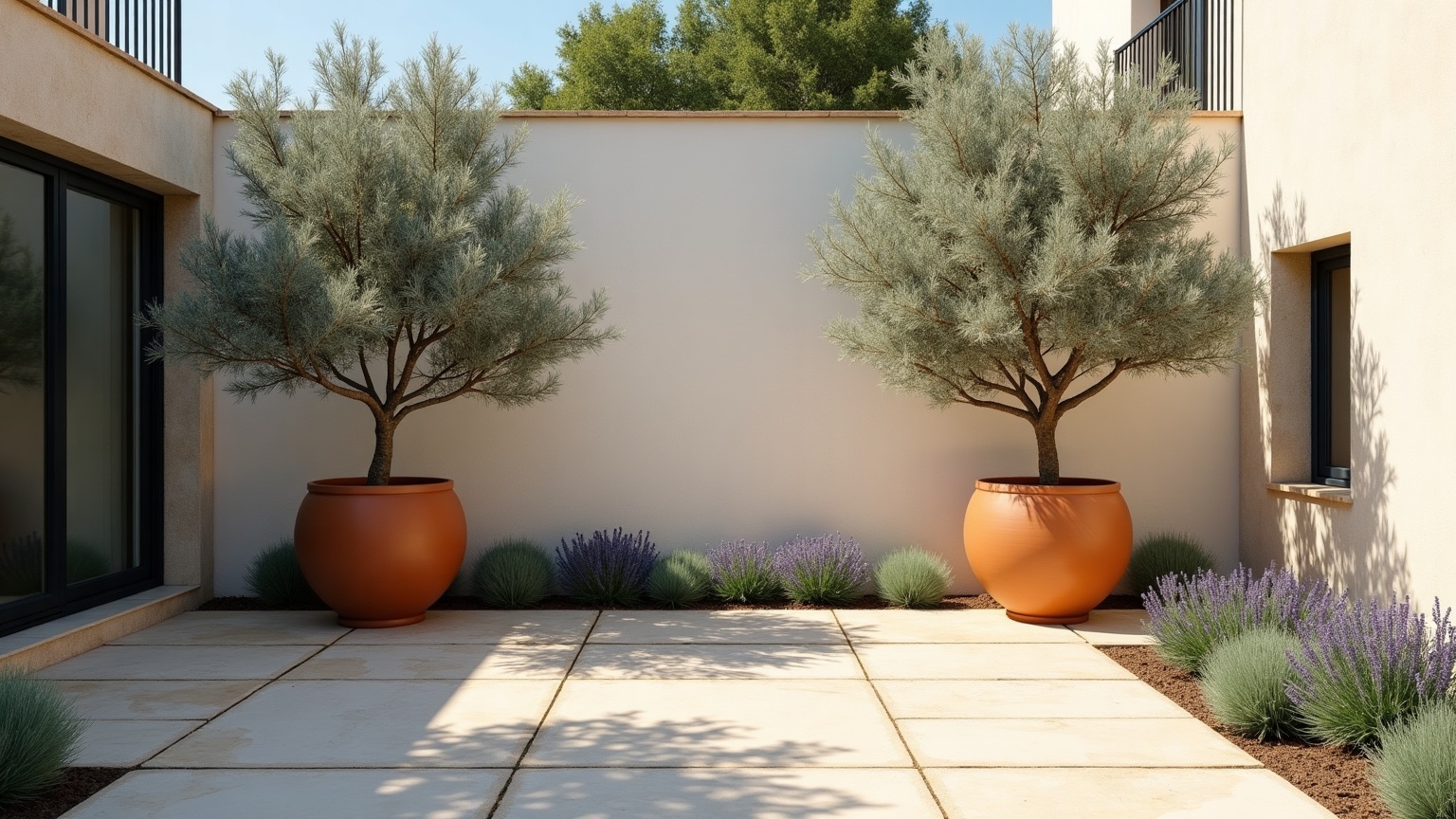
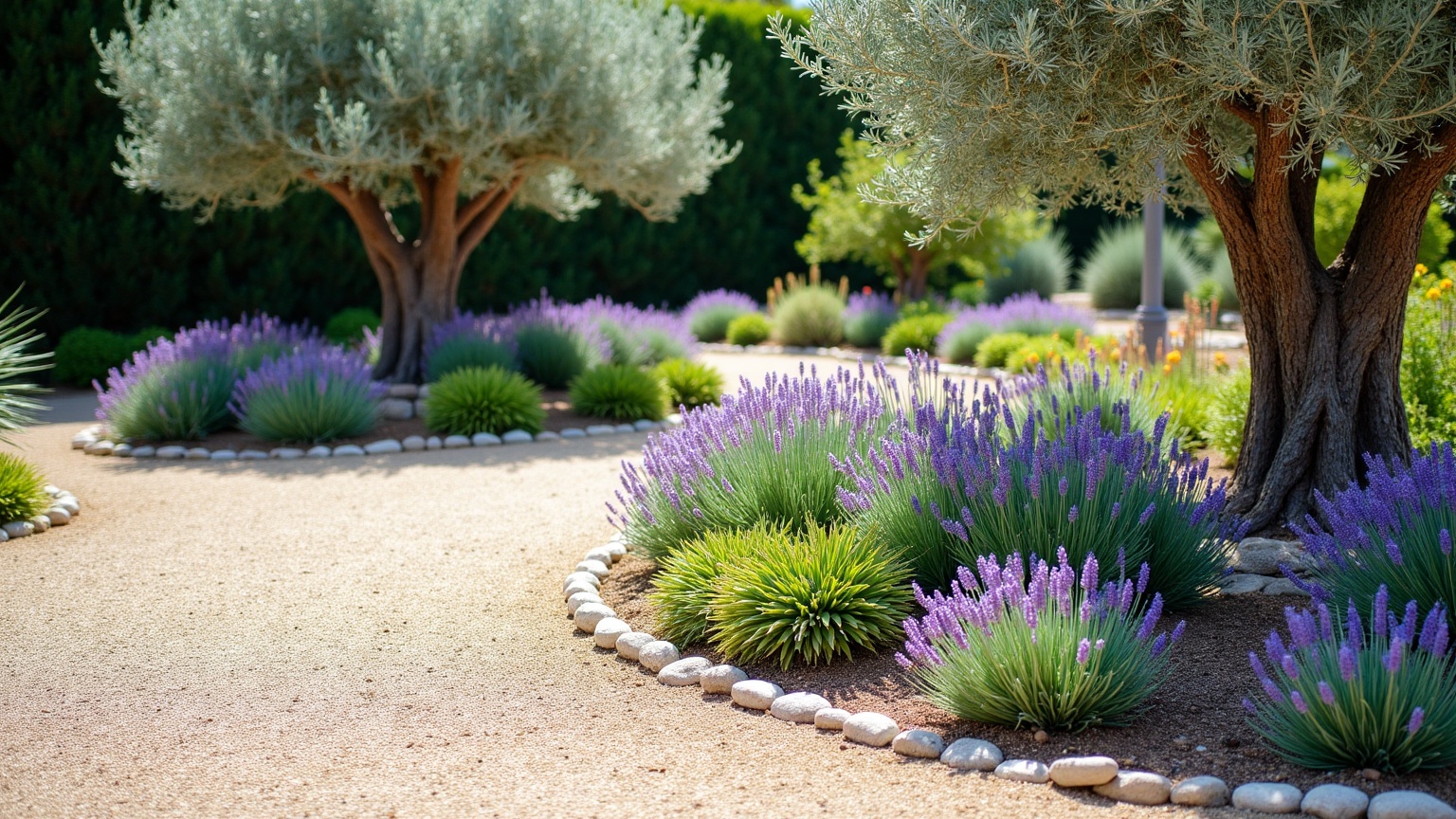
- Hard, pale ground. Limestone, travertine, buff gravel or unglazed terracotta. The pale surface bounces light up into the silver foliage — that reflection is most of the effect.
- A restrained palette. Silver-green, terracotta, off-white, and one accent of blue or deep purple. Mediterranean planting reads as calm because the colour range is genuinely narrow.
- Mass, not variety. Three plants repeated twenty times, not twenty plants used once. This is the single most common mistake in home attempts at the style.
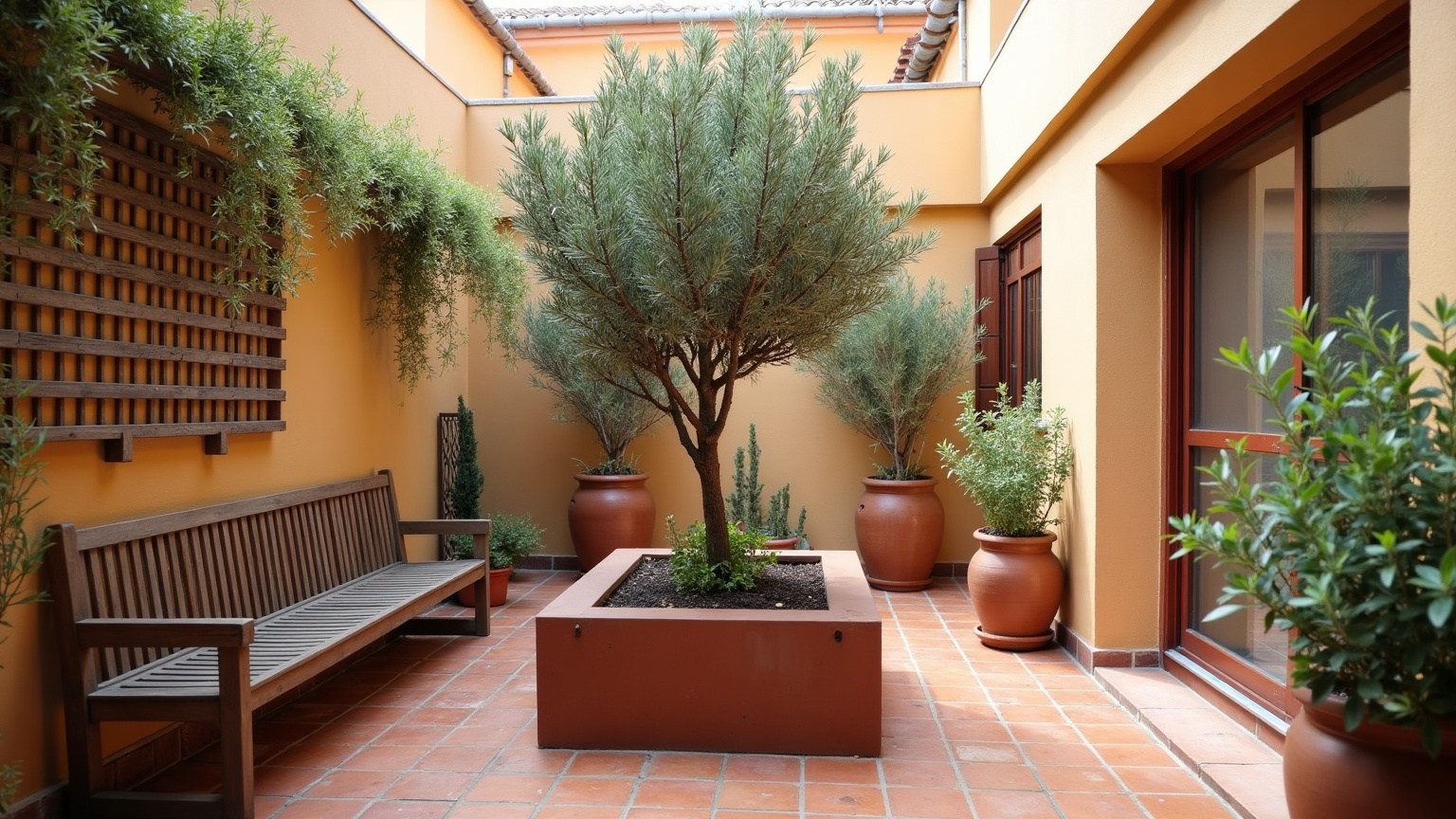
- Containers as architecture. Terracotta or corten pots large enough to read as structure, at least 60 cm across for a tree. Undersized pots make the whole scheme look temporary.
- Enclosure. A rendered wall, a clipped hedge, a pergola. The style comes from courtyards, and it collapses in an open, unbounded space.
Planting and care that keeps the tree alive
- Drainage first. In a pot, use a 50/50 mix of soil-based compost (John Innes No. 3 or equivalent) and coarse grit or perlite. Never use a peat-based multipurpose compost on its own — it holds water and rots the roots.
- Pot size. Start at roughly 45–50 cm diameter for a young tree and step up one size every three or four years. Terracotta beats plastic here because it breathes and dries out faster.
- Watering. Deep and infrequent. Let the top 5 cm dry out completely between waterings — typically once a week in high summer, once a month or less in winter. Yellowing leaves usually mean too much water, not too little.
- Feeding. A balanced slow-release fertiliser once in spring is enough. Overfeeding produces soft growth that will not survive a cold snap.
- Pruning. Late spring, after the frost risk has passed. Open the centre of the canopy so light and air get through, and remove suckers from the base. Olives tolerate hard pruning well.
- Fruit. An olive needs a long hot summer to ripen fruit. In cool-temperate climates treat it as a foliage plant and be pleasantly surprised if it crops.
What to plant with it
Everything below wants the same conditions as the olive — full sun, sharp drainage, low fertility — so nothing in the bed is fighting for different treatment:
| Plant | Role | Notes |
|---|---|---|
| Lavandula angustifolia | Low mass, scent | Hardier than French lavender. Cut back hard after flowering or it goes woody. |
| Rosmarinus officinalis | Structure, evergreen | Upright forms for height, prostrate forms to spill over a wall or pot edge. |
| Santolina chamaecyparissus | Silver mound | Clips into tight domes — useful for repeating rhythm along a path. |
| Cistus (rock rose) | Flowering shrub | Short-lived but fast. Handles drought and poor soil better than almost anything. |
| Stipa tenuissima | Movement | Fine grass that catches the light and softens hard paving. |
| Thymus and Origanum | Ground cover | Plant in paving joints and gravel where nothing else will grow. |
See it on your own garden before you buy anything
An olive of any size is expensive, and the Mediterranean look depends heavily on proportion — the size of the tree against the wall, the pot against the paving. That is difficult to judge from a plant label. Testing it on a photo of your actual space takes about a minute:
- Take a photo of the space in daylight, standing where you normally look at it from.
- Upload it to Ogrovision and pick a Mediterranean style from the preset library, or type what you want in your own words — for example: an olive tree in a large terracotta pot, gravel ground, lavender along the wall.
- Use Precise Editing if you want control over placement. Draw a coloured zone over the exact spot where the tree should go and describe only that area, leaving the rest of the photo untouched. You can also upload a reference photo of a pot or a specific tree and have it placed in the marked zone.
Signing up gives you free credits and does not need a card, which is enough to compare two or three arrangements before committing. A standard visualisation costs 1 credit; packages start at $2.99 for 10 credits, and credits do not expire. Full details are on the pricing page.
What it costs
- Young olive (1.2–1.5 m, slim trunk): roughly €40–90 / £35–80.
- Specimen olive (thick gnarled trunk, 20+ years): €400–2,000+ depending on trunk girth. Trunk character, not height, sets the price.
- Large terracotta pot (60 cm): €60–150. Check it is frost-proof, not merely frost-resistant.
- Gravel mulch: around €4–8 per m² at a 5 cm depth, plus a permeable membrane underneath.
- Companion planting: €5–12 per plant, and you will need more of them than you think — plan on 5–7 lavenders per linear metre of bed for a solid drift.
Frequently asked questions
In USDA zone 8 and warmer, yes — in open ground, in full sun and free-draining soil. In zone 7 and below, grow it in a container and move it somewhere frost-free and unheated for the winter. Wet soil at low temperatures is what kills olives, so drainage matters more than the temperature itself.
Leccino, which tolerates roughly −12 °C once established. Arbequina is the usual choice for containers because it stays compact and is self-fertile, but it is a few degrees less hardy.
Deeply but rarely. Let the top 5 cm of compost dry out completely first — about once a week in high summer and once a month or less in winter. Yellow leaves on an olive almost always mean overwatering.
Plants that want the same dry, sunny, low-fertility conditions: lavender, rosemary, santolina, cistus, thyme and Stipa tenuissima. Repeat three or four of them in large drifts rather than planting one of everything.
Only where summers are long and hot enough to ripen the fruit. In cool-temperate climates treat an olive as an evergreen foliage plant — any crop is a bonus, and the fruit needs curing before it is edible anyway.
Upload a photo of your garden to Ogrovision and either choose a Mediterranean preset or describe the scheme in your own words. The Precise Editing mode lets you mark the exact spot for a tree or a pot so only that area changes. Free credits on signup are enough to test a few arrangements before buying plants.